
Practicing Yoga with Chronic Pain
Not to be dramatic, but I have never known a life without pain.
My body has always been a puzzle to me. Pain shows up unpredictably, and what feels fine one day can leave me struggling the next. For years, I was told some version of the same thing: rest, take anti-inflammatories, you'll be fine. But I wasn't fine. By my mid-twenties, I was in pain somewhere in my body every single day.
It wasn't until I was 25 that someone finally gave me language for what I was experiencing: hypermobility. Later, I would come to understand this as part of Ehlers-Danlos Syndrome, a condition that means my joints move too much, my body works overtime to stabilize itself, and injuries don't always show up the way they "should."
Movement became both a lifeline and an enigma. When I started working with a physical therapist, I began to understand my body differently: how to pay attention, how to stabilize, and how to move in ways that actually helped instead of hurt. Over time, I found my way into running, strength training, and eventually yoga.
And that's where things get complicated. When I first started to understand what was happening in my body, yoga wasn't exactly encouraged. My joints already moved too much. Flexibility wasn't the goal for me, stability was.
And yet, somehow, yoga became part of my story anyway.
Over time, I had to unlearn a lot about what yoga was supposed to be. Not because yoga is inherently harmful, but because the way it's often taught didn't match the reality of my body.
This is what I've learned about practicing yoga in a body with chronic pain:
"Yoga did give me a way to be in my body with more awareness, more choice, and more compassion."
For a long time, I thought I was "good" at yoga because I could go deep into poses. But in a hypermobile body, depth isn't always a strength. In fact, it can be a liability.
What I needed wasn't to stretch further. I needed to learn how to stop before the end range. I needed to build strength in smaller ranges of motion and to feel what stability actually is. This is actually something I need to hold in my mind every single time I step on the mat. Sometimes the most skillful version of a pose is the one that looks like you're doing less.
There are days when a full practice isn't accessible to me. There was a time when I would have called that a failure. Now, I understand that a few minutes of intentional movement, done with awareness, is often more supportive than pushing through a longer practice my body can't sustain.
This can be as simple as: a subtle shift of weight from one foot to the other in Mountain Pose, taking extra time to move from hands and knees into a low lunge instead of rushing through it to keep up with others in the room, or one breath where I actually notice: Where am I holding tension? What is working harder than it needs to?
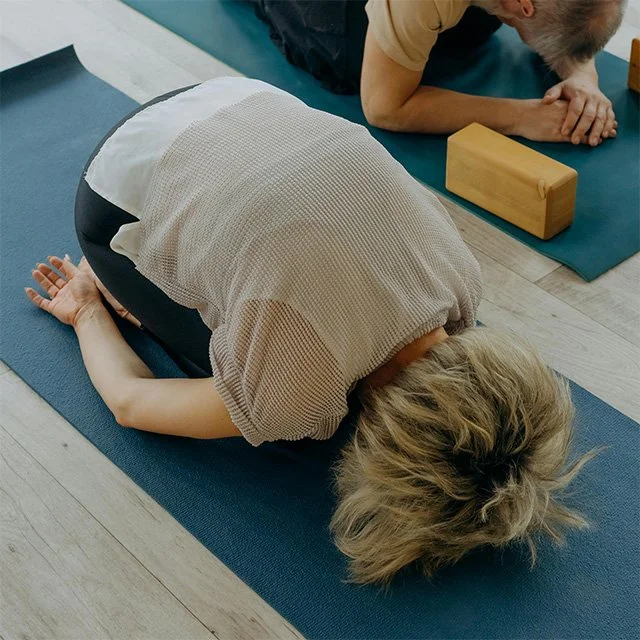
One of the most confusing parts of living in my body is that pain doesn't always mean the same thing. Sometimes it means stop. Sometimes it means adjust. Sometimes it's just… there.
Yoga spaces often rely on simple cues like "if it hurts, don't do it." But for those of us in chronic pain, that's not always helpful. I've had to learn a more nuanced language: What kind of pain is this? Is it increasing, decreasing, or staying the same? What happens if I change something slightly?
That kind of listening takes time. And patience. And a lot of trial and error.
I used to believe that progress in yoga came from doing the same thing regularly, but chronic pain doesn't operate on a predictable schedule. There are days I feel strong and capable, and there are days I feel like I'm starting over. Consistency, for me, isn't about doing the same practice every day. It's about continuing to come back, even when what I'm able to do looks completely different.
This might be the hardest one. Yoga culture often places a lot of trust in the teacher: follow the cues, trust the sequence, do what's offered. But in a body like mine, that doesn't always work. I've had to learn how to ignore cues that don't serve me, opt out without explanation, change poses in ways that make sense for my body.
I almost always check-in with instructors before class if I'm dealing with something specific that I know will limit my participation (right now, it's arthritis and an MCL sprain in my knees slowing me down), but it took me a long time to feel confident enough to do so. Some days it's still hard not to overexplain. But at the end of the day, no one else is living in this body, and I'm the only one who can advocate for what I need.
Final thoughts
Yoga didn't fix my pain. It didn't cure my condition, and it certainly didn't make my body follow the rules.
But yoga did give me a way to be in my body with more awareness, more choice, and more compassion. For me, that's where the practice lives now: not in how deep I go into a pose, but in how well I can listen when my body asks me to do something different.